
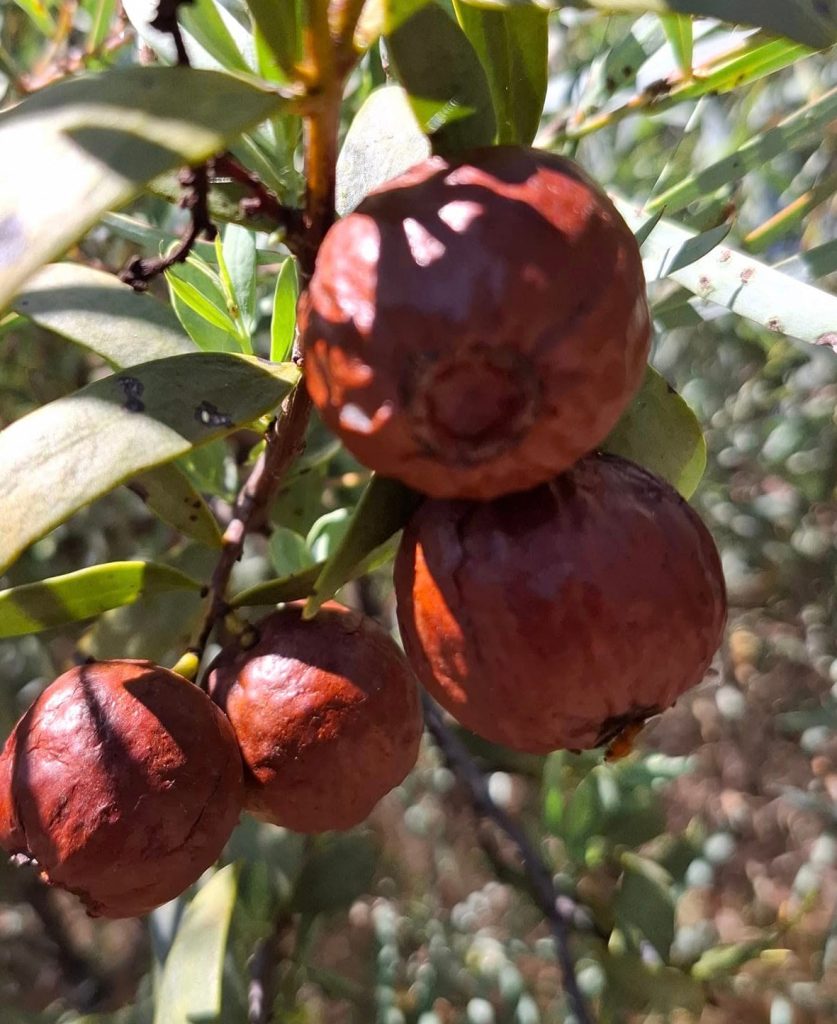
Santalum spicatum (Australian Sandalwood) is one of four species of the family Santalaceae to occur in Western Australia, and is native to semi-arid areas in the Southwest. It has a similar distribution to quandong (Santalum acuminatum) and is a hemi-parasite requiring macronutrients from the roots of hosts. It has a shrubby to small tree habit, but can grow to 6 metres and is tolerant of drought and salt. Sandalwood are protected and listed as a Vulnerable threatened species on the IUCN Red List (2021). For sale of timber and seeds a permit is required.
The foliage is grey-green in colour. Small cream coloured flowers occur late summer early autumn with fruit mature for picking from late spring. The fruit is spherical, about 3 centimeters in diameter, and orange in colour. An edible kernel with a hard shell forms the bulk of the fruit; the shell is smoother than S. acuminatum’s deeply pitted surface.
Like other members of its genus, Sandalwood is hemiparasitic, able to photosynthesize, but using the root system of other plants to acquire nutrients other than sugars. Sandalwood attaches to other species, in a nondestructive way, sustaining itself by their provision of nitrogen, shade, and water. The roots of the species have pad-like adaptations, haustoria, that nearly encircle the host’s root, which is typical of this genus of sandalwoods. Hosts can be other trees, shrubs, or grasses, usually several plants are used. This mechanism allows the plant to acquire 70% of its nitrogen, and some of its water requirements from the roots of other trees and shrubs.
Sandalwood occupies a diverse and widespread range of habitats, including creek beds, granite, gravel plains, and sandy dunes. It is tolerant of drought, salt, and high temperatures, and poor nutrient soils. The seedling can become established in the shade of its host, reaching for full sun once developed, so the plant is usually intermingled with host and other species.
Sandalwood is a versatile and valuable tree, offering edible nuts, shade, and the iconic sandalwood oil. Its semi-parasitic nature adds a unique dimension to its cultivation, making it a fascinating addition to bush food gardens or native landscaping projects.