
This guide compiles practical, research-backed steps for establishing and maintaining
Quandong and Sandalwood in Western Australia.
Further general Australian Santalum history information is Here.
Information regarding other species including the Blue Quandong is Here
A video of potting Germinated Seed can be found on our YouTube Channel Here
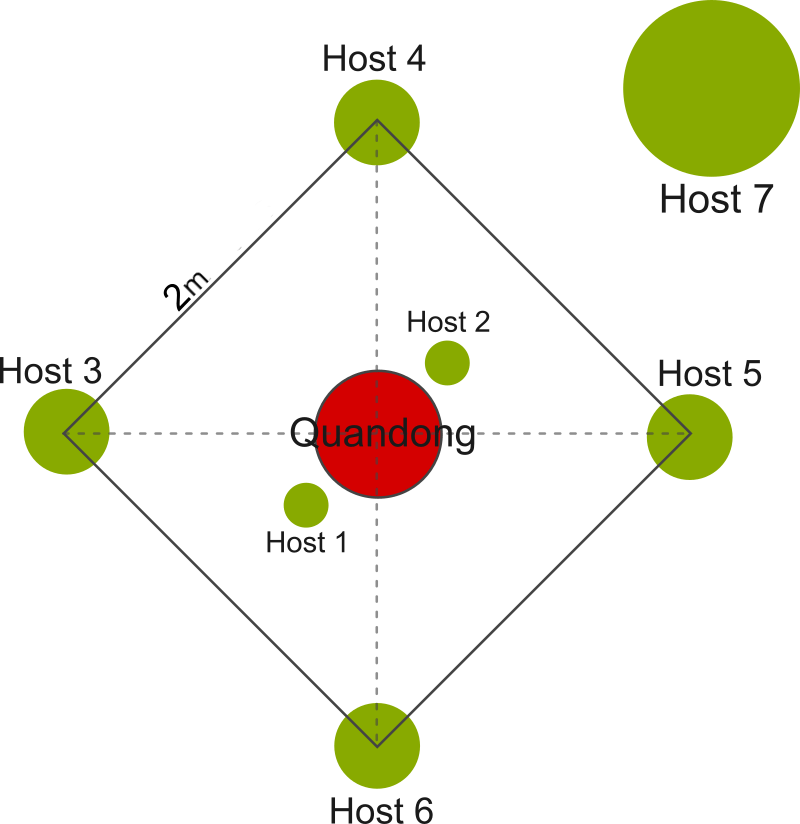
distance varying from host based on size and age e.g. Saltbush > Acacia
- 1. Understanding the Plant
- 1.1 Santalum acuminatum
- 1.2 Santalum spicatum
- 2. Climate & Site Selection (WA)
- 3. Soil Requirements
- 4. Host Plants & Establishment
- 5. Planting & Mulching
- 6. Watering
- 7. Fertilization
- 8. Pests & Diseases
- 9. Harvesting & Use
- 10. Troubleshooting – Common Issues (WA)
- 11. Quick-Start Checklist (WA)
- 12. References & Further Reading
1. Understanding the Plant
Santalum belongs to Santalacea family of plants a lineage of hemi-parasitic (forms haustoria to draw water and nutrients from nearby hosts) shrubs and trees.
1.1 Santalum acuminatum
- Once established drought-tolerant shrub/small tree (2 – 6 m).
- Native to semi-arid areas of Western Australia, South Australia and NSW
- Fruit: bright red drupes (15 – 25 mm) with tart flesh; kernel inside a hard nut.
1.2 Santalum spicatum
- Native to semi-arid areas of Western Australia and South Australia
- Small shrubby tree grows 2-6m
- Orange fruit 30mm in diameter, edible nut.
- Oil harvested from wood and nuts
2. Climate & Site Selection (WA)
- Best suited to inland/arid/semi-arid zones; young plants are frost-sensitive.
- Sunlight: at least 6 – 8 hours/day; select open locations sheltered from cold winds.
- Spacing: quandongs 3 – 5 m apart; hosts positioned 0.1 – 2 m from each plant.
- Both species are desired for tolerance of West Australian conditions.
3. Soil Requirements
- Well-drained sandy or loamy soil; avoid heavy clay and water-logging.
- Target pH: 6.0 – 7.5. Improve drainage with coarse sand/perlite and organic matter.
- Annual soil testing recommended; raise beds where drainage is marginal.
4. Host Plants & Establishment
- Preferred hosts: Acacia spp., Casuarina spp., Old Man Saltbush (Atriplex nummularia), native grasses, legumes
- Plant multiple hosts per tree to reduce reliance on any single host.
- Manage competition: prune hosts lightly and avoid aggressive species that out compete seedlings.
5. Planting & Mulching
- Do Not Damage or Handle the root system, seedlings potting mix should be left to dry and potting bag should slide or be cut off without breaking apart the mix. If supplied with a starter host do not separate. If host is outgrowing the Santalum it can be pruned back, if the host becomes non desirable then it can possibly be culled once the Santalum has established other hosts.
- Recommended time for planting seedlings is between late March to September (All year if in pots). Seedlings are not weather hardened and planting immediately in hot weather in direct sunlight is not recommended. Wait till the weather cools or move/shade plant away from midday sun until hardened.
- Plant in full-sun to part shade based on time of year.
- Protect from winds and frost while establishing.
- Mulch (straw/wood chips) to suppress weeds and moderate soil moisture; keep mulch clear of stem base.
6. Watering
- Young plants: regular watering until established; avoid saturated soils.
- Mature plants: drought-tolerant; irrigate during prolonged dry spells only.
7. Fertilization
- Use low-phosphorus native-safe fertilizers or balanced slow-release (apply spring and summer).
- Organic options: compost, well-rotted manure, fish emulsion; avoid over-fertilizing.
- Monitor deficiencies: yellowing (N), poor fruit set (P), weak growth (K).
8. Pests & Diseases
- Quandong moth (Paraepermenia santaliella), is the most significant insect pest. Minor pests include aphids, scale insects, spidermites, mealybugs; inspect regularly.
- Controls: neem oil, insecticidal soap; encourage beneficials (ladybirds).
- Disease risks: root rot in poorly drained soils; reduce humidity and improve airflow.
9. Harvesting & Use
- Fruit after 3 – 4 years under good conditions; ripens late spring to early summer.
- Sandalwood can be harvested for multiple purposes reference information.
- Quandongs are ornamentally used in landscaping and desired for longevity. Use fresh, dried, or processed (jams, sauces, pies); kernels have traditional uses.
10. Troubleshooting – Common Issues (WA)
Problem Likely Cause; Action
- Yellow leaves Nitrogen deficiency; weak host connection Apply native-safe fertilizer; check host health/proximity; add mulch.
- Stunted growth Inadequate host; poor drainage Add/prune hosts; amend soil with sand/perlite; use raised beds; wind protection.
- Root rot Water-logging/heavy clay Improve drainage; reduce irrigation; plant on mounds.
- Pests (moths/aphids/scale/mites) Sapsucking insects Neem/insecticidal soap; encourage beneficials; prune affected tips.
- Poor fruit set Limited pollination; nutrient imbalance Plant multiple trees; increase K during flowering; avoid excessive N.
- Host dominance Aggressive host competition Prune host canopy/roots; maintain 1 – 2 m spacing.
- Frost damage (young) Cold snaps Use frost cloth; choose sheltered micro-sites.
- Young plants may show purplish leaves during winter in bags, a sign of over-watering.
11. Quick-Start Checklist (WA)
Select full-sun site (4 – 8 h/day); sandy/loamy soil, pH 6.0–7.5.
Prepare soil with compost + coarse sand/perlite if required (well draining native ground); remove weeds, mounding can be used.
Choose hosts; plant smaller shrubs 0.1–2 m from quandong/sandalwood depending on host root system.
Clover or grass can be used as a close permanant or temporary host. Do not disturb root systems, hosts can be culled when larger established.
Space larger trees 3 – 10 m.
Water regularly until established; avoid waterlogging.
Protect from winds.
Fertilize lightly in spring/summer with native-safe products.
Monitor pests monthly; treat early with neem/insecticidal soap.
Expect first harvest ~3 – 4 years; pick red fruit late spring–summer.
12. References & Further Reading
ANBG Growing Native Plants – Santalum acuminatum: ABNG
ANPSA – Propagation of the Quandong (Ben Lethbridge): ANPSA
Atlas of Living Australia Santalum spicatum: Atlas
Australian Native Plant Society (Australia) Santalum acuminatum: ANPSA
Australian Sandalwood Network: ASN
Plantiary – Santalum acuminatum overview: Plantiary
PIRSA Fact Sheet – Quandong production: PIRSA
Prolific or precarious: a review of the status of Australian sandalwood The Rangeland Journal