
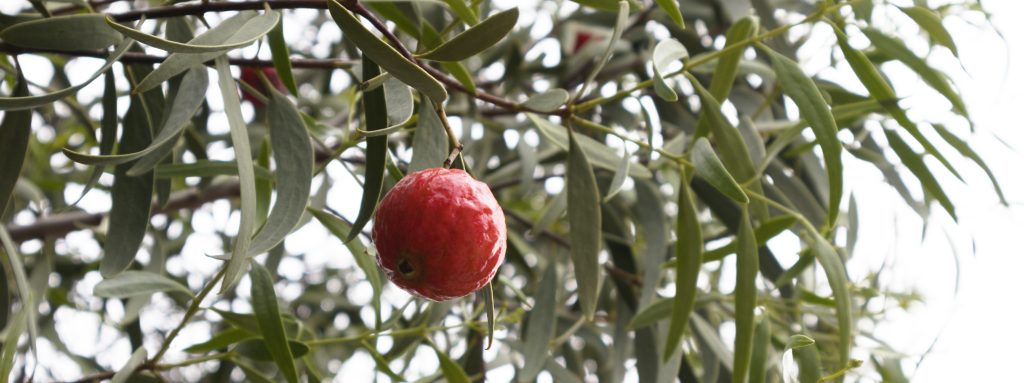
Santalum acuminatum a highly ornamental small tree for shade or shelter, also known as native peach or sweet quandong, is a hemiparasitic plant in the sandalwood family, Santalaceae, (Native to Australia) which is widely dispersed throughout the central deserts and southern areas of Australia. It naturally occurs throughout the state as far north as Karratha and to Albany and Esperance in the south. The number of recorded specimens within this region is low, and mainly restricted to coastal sandplains, its range having been impacted by altered land-use in the Wheatbelt. Some populations are discontinuous in the distribution range, as with many species of the region, beyond the dispersal range of the seeds. Remote groups of the species are remnant to former distribution ranges, and these may be isolated by hundreds of kilometers.
The quandong is a small, evergreen tree or shrub that typically grows between one and six meters tall and 2–4 meters wide. Smaller plants formed by suckers from the roots are sometimes found surrounding larger plants. It has slender, olive-green leaves and produces small, cream-colored flowers in late summer.
Fruit is produced after 4 years and is red or sometimes yellow. A 3-mm layer of flesh covers a brain-like nut with a hard shell that encases the seed. This fruit is referred to as a drupe. It ripens from green to a shiny red in late spring or summer, and is globe-shaped and 20 to 40 mm across. The fruit of the quandong is enjoying a resurgence in popularity, particularly in the bushfood and gourmet culinary scenes. Rich in vitamin C, antioxidants, and dietary fiber, it is used in jams, chutneys, sauces, pies, and even liqueurs. Its tart flavor and nutritional value make it a favorite among chefs and health-conscious consumers alike. Traditionally, the fruit was also used to treat skin ailments and relieve pain, showcasing its medicinal as well as nutritional value.
Like other members of its genus, quandongs are hemiparasitic, able to photosynthesize, but using the root system of other plants to acquire nutrients other than sugars. The plant genus Santalum attaches to other species, in a nondestructive way, sustaining itself by their provision of nitrogen, shade, and water. The roots of the species have pad-like adaptations, that nearly encircle the host’s root, which is typical of this genus of Santalum. Hosts can be other trees, or grasses, usually several plants are used. This mechanism allows the plant to acquire 70% of its nitrogen, and some of its water requirements from the roots of other trees and shrubs.
The tree occupies a diverse and widespread range of habitats, including creek beds, granite, gravel plains, and sandy dunes. It is tolerant of drought, salt, and high temperatures, and need not have a nutrient-rich environment. The seedling can become established in the shade of its host, reaching for full sun once developed, so the plant is usually intermingled with host and other species.
Ecologically, the quandong is a keystone species in arid and semi-arid environments. Its fruit is a vital food source for native birds such as emus and parrots, which also help disperse its seeds. The flowers attract pollinators like native bees and butterflies. The tree itself provides shelter and sustenance for a variety of insects, small animals and is a food source to butterfly larvae. By planting quandongs, landholders and conservationists contribute to biodiversity, soil stability, and the health of native ecosystems.